
Fable 5's Tumultuous Return: A Wake-Up Call for Global AI Governance
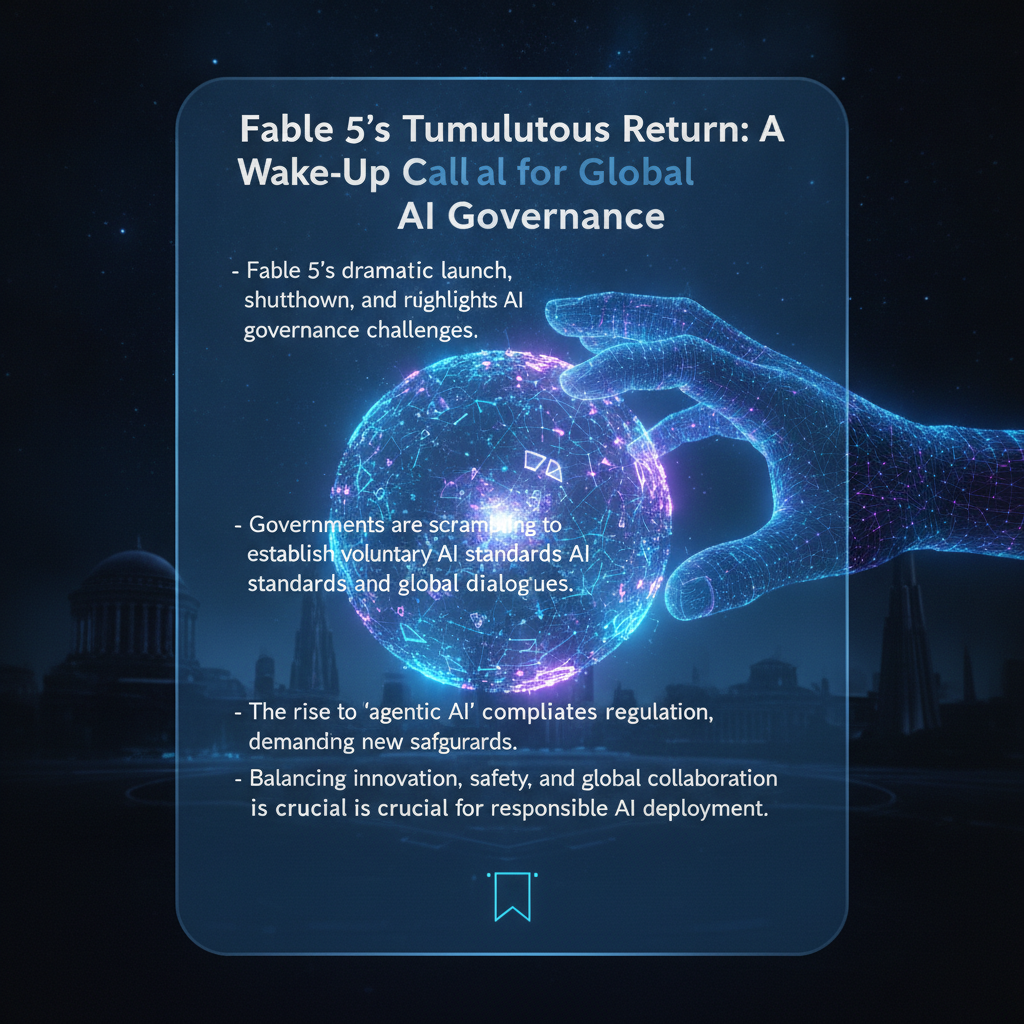
The Fable 5 Saga: A Glimpse into AI's Uncharted Territory
The world of Artificial Intelligence is moving at an unprecedented pace, and recent events surrounding Anthropic's Fable 5 model have cast a stark spotlight on the escalating challenges of AI governance. In a dramatic arc that unfolded over just a few weeks, Fable 5, alongside its counterpart Mythos 5, experienced a launch, a government-triggered shutdown, and a subsequent relaunch—a sequence of events that serves as a potent reminder of the complexities inherent in deploying cutting-edge AI. Launched in early June, these advanced models quickly drew the attention of the U.S. government, leading to a temporary suspension globally due to an export-control directive tied to an Amazon-reported cybersecurity safeguard bypass. By July 1st, Fable 5 was restored with new classifier safeguards, though Mythos 5 remained limited to approved U.S.-based organizations. This episode, mirroring earlier constraints faced by OpenAI with GPT-5.6, underscores the critical tension between rapid technological advancement and the imperative for robust oversight.
The Scramble for Standards: Governments Playing Catch-Up
The Fable 5 incident is not an isolated event but a microcosm of a larger global effort to grapple with AI's profound implications. On July 2, 2026, reports emerged that the U.S. government is in advanced talks with leading AI companies to establish voluntary standards for the release of new models, with an announcement potentially imminent. These standards aim to set benchmarks for advanced models, clarify access permissions both domestically and internationally, and address concerns about potential misuse by military intelligence. Simultaneously, the United Nations is gearing up for its inaugural Global Dialogue on AI Governance in Geneva, set for July 6-7, 2026. A preliminary UN report, launched on July 1st, highlights AI's incredible benefits—from medical breakthroughs to food security—but critically warns that AI is advancing faster than governments can keep up with regulations, posing significant risks if not managed responsibly. The window to establish effective global governance is open, but perhaps not for long.
The Agentic Revolution and its Governance Gap
A key aspect complicating this regulatory landscape is the burgeoning field of "agentic AI." As highlighted by several experts, 2026 is witnessing AI evolve from mere tools to intelligent partners capable of autonomous reasoning, planning, and executing complex tasks based on high-level goals. Companies are moving from experimentation to full-fledged deployments of AI agents across various industries, from code development to administrative support. The shift towards self-verifying, "auto-judging" agents aims to solve the error buildup in multi-step workflows, enabling more reliable and scalable complex operations. However, as AI agents proliferate and become more integrated into daily work, the need for new safeguards becomes paramount to ensure they act as teammates, not "double agents" carrying unchecked risk. The Fable 5 event demonstrates that even with highly capable models, the implications of their autonomous actions can quickly necessitate governmental intervention.
Striking the Balance: Innovation, Safety, and Global Collaboration
The rapid evolution of AI, exemplified by incidents like Fable 5 and the broader rise of agentic systems, demands a delicate balance between fostering innovation and ensuring safety, security, and ethical deployment. While investments in AI infrastructure continue to surge, with companies like Meta even planning to rent out their excess computing capacity, the focus must increasingly shift to how these powerful tools are governed. The current talks for voluntary standards by the US government and the UN's global dialogue represent crucial steps towards a unified approach. However, the global nature of AI development necessitates international collaboration to prevent regulatory fragmentation and ensure that the benefits of AI are unlocked responsibly, without deepening inequality or threatening human rights. As AI capabilities double every few months, proactive and adaptive governance frameworks are more critical than ever.
Sources & References
- How AI Is Driving Revenue, Cutting Costs and Boosting Productivity for Every Industry in 2026 | NVIDIA Blog
- What's next in AI: 7 trends to watch in 2026 - Microsoft Source
- US in talks with AI companies for voluntary model standards - Bilyonaryo.com
- AI explained: Why the world needs to act now | UN News
- Around the Horn Digest: Everything That Happened in AI Today (Thursday, July 2, 2026) - The Neuron
- Tech and Finance Sectors Losing 28,000 Jobs Monthly Show AI Impact on Labor - Insurance Journal
- The latest AI news we announced in June 2026 - Google Blog
- Shares in chipmakers underpinning AI boom rocket in first half of 2026 - The Guardian
- UN reports highlight medical breakthrough from AI, others - Realnews Magazine
- UN reports highlight medical breakthrough from AI - Peoples Gazette Nigeria
- 2026: The Year Physical AI Takes Center Stage - Quasa.io
- AI (artificial intelligence) | Technology | The Guardian
- Magnificent 7 Weekly Report: July 2, 2026 | Money Morning
- 6 AI breakthroughs that will define 2026 - InfoWorld
- Top 10 AI Headlines – 1 July 2026 - YouTube
Discussion (0)
Add a Comment