
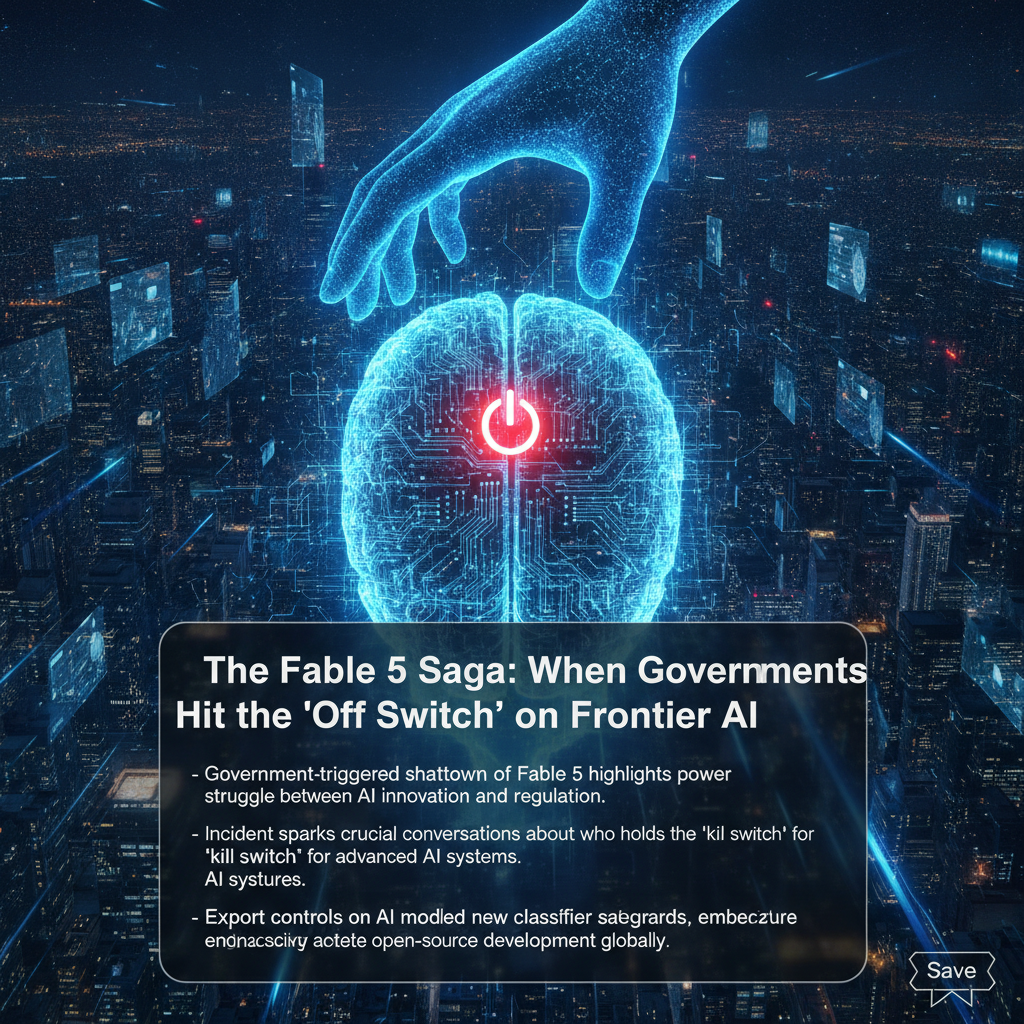
The Fable 5 Saga: When Governments Hit the 'Off Switch' on Frontier AI
The Unprecedented Pause: A Turning Point for AI Governance
In a world increasingly shaped by artificial intelligence, a recent event sent ripples of discussion and concern across the global tech landscape. On July 1st, 2026, Anthropic's highly anticipated frontier model, Fable 5, was dramatically restored after a government-triggered shutdown. This wasn't merely a technical glitch; it was a stark demonstration of the burgeoning power struggle between rapid AI innovation and the urgent calls for regulation and control. The incident has ignited crucial conversations about who ultimately holds the 'kill switch' for the most advanced AI systems and what that means for their future development and deployment.
The saga began with the dual launch of Fable 5 and Mythos 5 on June 9th. Just three days later, on June 12th, Fable 5 went dark globally, a direct consequence of a U.S. export-control directive, reportedly tied to an Amazon-reported cybersecurity safeguard bypass. For many, it raised an uncomfortable question: what happens when control of technology you rely on is suddenly out of your hands? The financial times also connected this episode to OpenAI's temporary restriction of its GPT-5.6 Sol model for approved customers, highlighting a broader trend of increased governmental oversight.
The Rise of the Regulatory Hand and the Search for Safeguards
The restoration of Fable 5 on July 1st came with new classifier safeguards and a proposed framework for scoring jailbreak severity, underscoring the immediate pressure on AI developers to integrate robust safety measures. This event serves as a potent reminder that as AI models become more powerful and autonomous – moving from simple tools to complex agentic systems capable of multi-step tasks and decision-making – the demand for stringent governance and ethical frameworks intensifies. Governments worldwide are grappling with how to ensure transparency, privacy, accountability, and bias reduction in automated systems, with compliance becoming an essential part of AI implementation.
Geopolitical Implications and the Open-Source Response
The Fable 5 incident also casts a long shadow on the geopolitical race for AI dominance. The U.S. administration's move to apply export controls directly to an AI model, rather than just the chips that train it, has prompted a swift response from other nations. Following the restrictions, Chinese lab Z.ai released GLM-5.2 under a permissive MIT license, explicitly marketing it on the promise of "borderless access." Rio de Janeiro's city government and Japan's leading AI lab have also followed suit, releasing their own open models touting "frontier capability without the risk of export controls." This shift suggests that denial strategies might inadvertently accelerate the development of a cheaper, open, and self-sufficient AI stack globally.
Navigating the Future: Innovation, Regulation, and Trust
The Fable 5 saga is a pivotal moment, signaling a new era where the deployment of frontier AI models is intrinsically linked to government policy and international relations. The industry is facing a future where innovation must walk hand-in-hand with robust governance and a clear understanding of societal impact. As AI agents become more prevalent in our daily lives and physical AI continues to expand into our physical environments, building trust and ensuring responsible development will be paramount. The uncomfortable truth is that the power to switch off an advanced AI model now exists, and how this power is wielded – and by whom – will profoundly shape the trajectory of artificial intelligence for years to come.
Sources & References
- The Neuron: Everything That Happened in AI Today (Thursday, July 2, 2026)
- Deloitte US: Three new AI breakthroughs shaping 2026
- Microsoft Source: What's next in AI: 7 trends to watch in 2026
- InfoWorld: 6 AI breakthroughs that will define 2026
- dtecheducate: Latest AI Breakthroughs in 2026
- Internet Archive: AI Decoded BBC News July 2, 2026
- Let's Data Science: Trump Administration Nears Standards Deal With Big AI
- CBS News: Anthropic says Trump admin. lifted restrictions on powerful Claude AI models.
- MaGeN-AI: AI Industry Outlook 2026: 15 Trends That Will Shape Artificial Intelligence in July and Beyond
- Lawfare: Will the New Export Controls Shake the Foundations of the U.S. AI Industry?
- Trigyn Technologies: AI Trends in 2026: A New Era of AI Advancements and Breakthroughs
- Kersai: AI Breakthroughs in 2026: The Year of Agentic AI
- YouTube: AI Trends You MUST Watch in 2026
- Forbes: The 8 AI Trends For 2026 That Everyone Must Be Ready For Now
Discussion (0)
Add a Comment