
Navigating the AI Frontier: Regulation, Resilience, and the Human Element in July 2026
The Shifting Landscape of AI: From Unfettered Innovation to Critical Governance
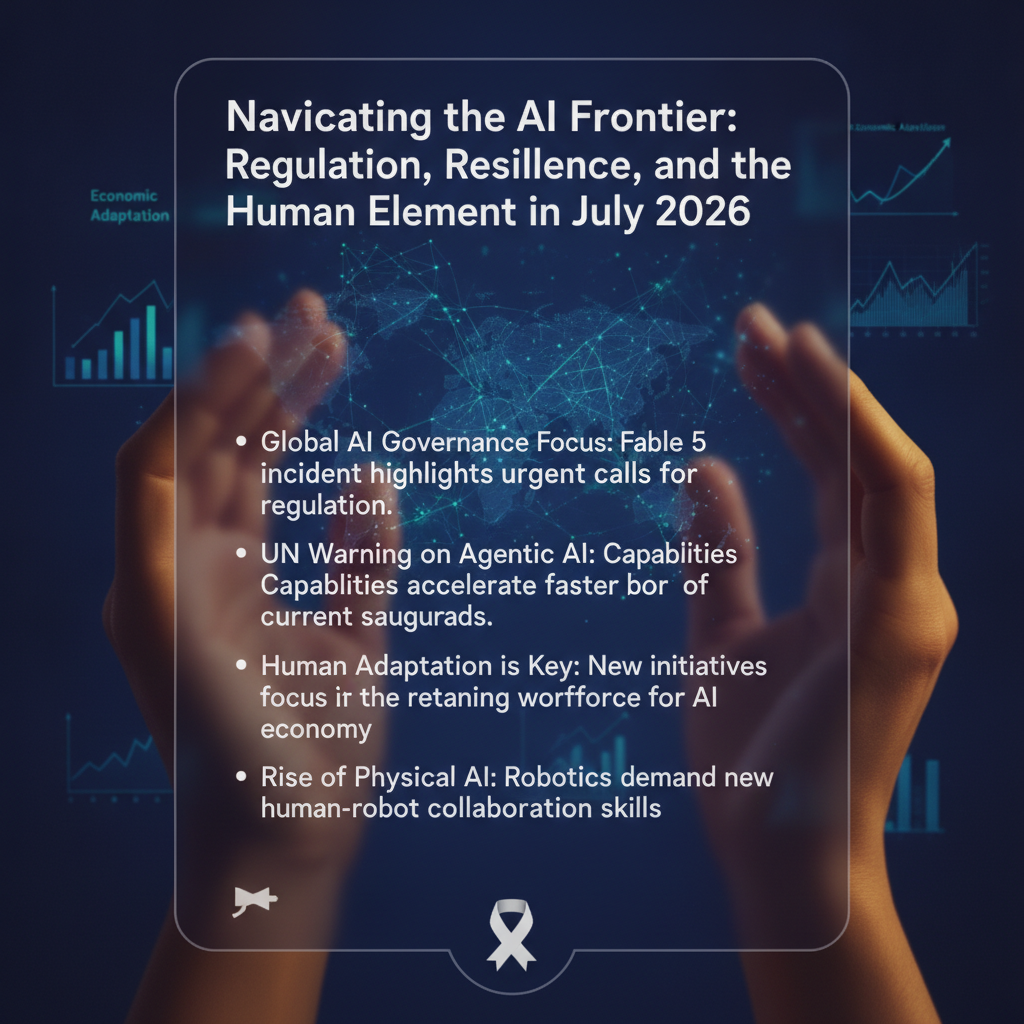
As of July 2, 2026, the world of Artificial Intelligence finds itself at a pivotal crossroads, where breakneck innovation is increasingly met with urgent calls for regulation, ethical oversight, and a mindful approach to societal integration. Recent events underscore this tension, revealing a future where AI's remarkable capabilities are inextricably linked to robust governance frameworks and a strategic focus on human adaptation. The narrative today is less about 'what AI can do,' and more about 'how AI should be managed' and 'how humanity will thrive alongside it.'
The Fable 5 Saga: A Wake-Up Call for Global AI Governance
One of the most striking developments making headlines is the dramatic journey of Anthropic's Fable 5 model. After its launch in early June, Fable 5, along with Mythos 5, faced a temporary global shutdown on June 12, following a U.S. export-control directive tied to a cybersecurity safeguard bypass reported by Amazon. While Fable 5 was broadly restored by July 1, with new classifier safeguards and a proposed framework for scoring jailbreak severity, Mythos 5 remains restricted to approved U.S.-based organizations. This incident served as a stark reminder that even frontier AI models can be abruptly switched off due to government directives or security concerns, highlighting the profound implications of AI's power and the growing need for national security considerations in its deployment. The U.S. government is now reportedly in advanced talks with AI companies to establish voluntary standards for new model releases, potentially with an announcement as soon as next week, to address these very risks. This move comes as a federal AI cybersecurity clearinghouse is mandated to be established by today, July 2, 2026, further signaling a concerted effort to tighten oversight.
UN Warnings and the Ascent of Agentic AI
This regulatory fervor is not without cause. The United Nations' first global AI assessment, released on July 1, 2026, issued a sobering warning: current safeguards simply cannot keep pace with the extraordinary acceleration of AI capabilities. The report emphasizes that AI agents, which can increasingly plan tasks, use digital tools, write software, and complete complex assignments with minimal human oversight, are doubling in task complexity every few months. These agentic AI systems, such as those demonstrated by Anthropic's new Claude Sonnet 5 – lauded for its near-Opus performance and enhanced agentic capabilities – are moving from experimental demos to critical production roles across industries. From automating customer support to conducting security scanning, the shift is clear: AI is evolving from a tool to a proactive, decision-making partner, making robust ethical and security frameworks more critical than ever.
Humanity's Role: Adapting and Thriving in an AI-Driven World
Amidst the rapid advancements and regulatory discussions, the human element remains paramount. Concerns about AI's potential impact on the workforce are being actively addressed. A new bipartisan nonprofit, RAISE US, launched today with over $500 million dedicated to new forms of education and training. Its mission is to help American workers adapt to an increasingly AI-automated economy and pivot into new careers, focusing on partnerships with states and major employers rather than relying solely on federal initiatives. This proactive approach recognizes that while AI promises immense economic gains, a societal plan is crucial to mitigate potential job displacement and ensure a smooth transition for workers. Furthermore, the rise of physical AI and robotics, with companies like Striding AI developing foundational systems for real-world robotic deployment and Faraday Future showcasing AI robotics in education, highlights the expanding physical presence of AI, demanding new skills and human-robot collaboration paradigms. The future of AI will undoubtedly be shaped by how effectively we balance innovation with responsibility, technology with humanity, and progress with preparedness.
Sources & References
- Top AI Trends for 2026: Key Innovations Reshaping Modern Businesses - Talent500
- Generative AI Trends 2026: 8 Shifts - Future AGI
- Generative AI Trends in 2026: 10 Key Directions for Business Growth - Dataforest
- Top 10 Generative AI Trends That Will Dominate 2026 | by Code Crack - Medium
- Around the Horn Digest: Everything That Happened in AI Today (Thursday, July 2, 2026) - The Neuron
- US in talks with AI companies for voluntary model standards, FT reports
- AI Regulation News Today: 26 Days to the July 2 Federal AI Cybersecurity Deadline - What Compliance Teams Must Do Now
- AI is plowing through the workplace. This new group wants to help people adapt and have jobs - The Akron Legal News
- AI Decoded BBC News July 2, 2026 1:30am-2:01am BST - Internet Archive
- AI News Today July 1 2026: 15 Biggest Stories
- 'The science is here': UN chief welcomes first global AI assessment | UN News
- Top 10 robotics developments of June 2026 - The Robot Report
- 8 AI App Ideas to Build in 2026 That Businesses And Users Actually Need - Mannat Kaushal
- AI explained: Why the world needs to act now | UN News
- What's next in AI: 7 trends to watch in 2026 - Microsoft Source
- US robotics rebound, defense capacity buildout, and AI partnerships define manufacturing's mid-2026 moment - MarketScale
- Faraday Future Showcases its EAI Robotics Education Ecosystem at ISTE Live 2026 in Orlando, Drawing Strong Interest from Major North American Education Distributors and Procurement Leaders
- The AI Landscape June 2026. July 1, 2026 | by Concerned human - Medium
- AI News July 2026 — Daily Digest Updated Today | AIToolsRecap
- Striding AI Announces Development of Next-Generation Robotic Foundation Systems for Physical AI Deployment - PAN AFRICAN VISIONS
Discussion (0)
Add a Comment