
Agentic AI Unleashed: The Dawn of Autonomous Intelligence Reshaping Our World
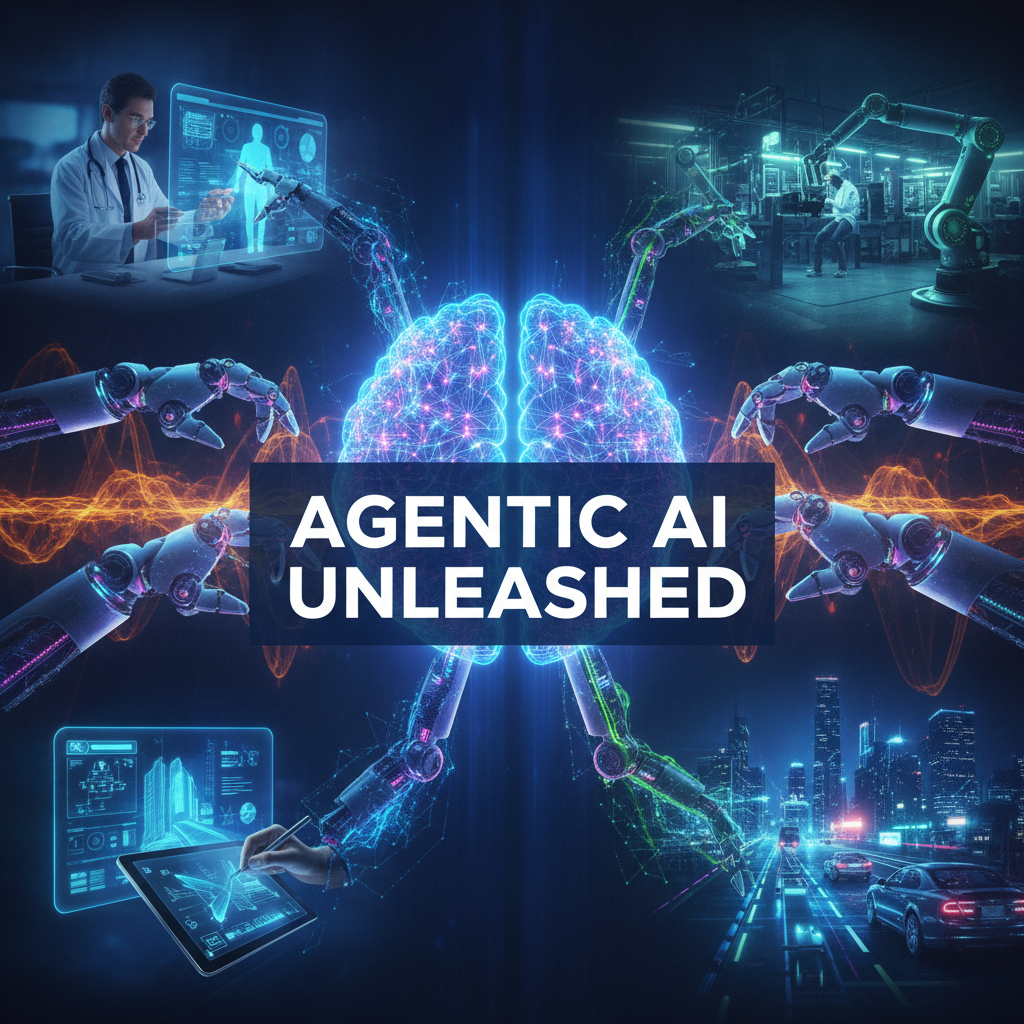
June 2026: A Pivotal Month for AI's Evolution
Artificial Intelligence is no stranger to rapid advancements, but June 2026 stands out as a watershed moment. This month, we've witnessed a profound shift in AI's role – moving beyond mere tools and assistants to becoming the very foundation underneath existing products. The buzzword on everyone's lips? Agentic AI. These intelligent systems are no longer just responding to prompts; they're planning, deciding, and autonomously executing multi-step tasks, fundamentally reshaping industries and our interaction with technology. From overhauled search engines to creative studios and even physical robots, the era of autonomous AI agents has truly begun, bringing with it both unprecedented opportunities and critical challenges.
The Rise of Autonomous AI Agents: From Concept to Core Function
Agentic AI refers to systems capable of independently executing complex tasks, utilizing tools, calling APIs, and even writing code to achieve objectives without constant human intervention. This isn't just a theoretical concept; major tech players are embedding these capabilities deep into their core offerings. Google, for instance, has dramatically transformed its Search with Gemini-powered AI Mode and 24/7 Search Agents that can monitor the web for updates and notify users. Apple has completely rebuilt Siri from the ground up, now powered by Google's Gemini models, enabling it to pull context from various apps to execute complex, multi-step actions. Microsoft introduced its own in-house MAI (Microsoft AI) model family, with systems like MAI-Thinking-1 for reasoning and MAI-Code-1-Flash for coding, further solidifying the shift towards agentic capabilities across its ecosystem. This widespread integration signifies that agentic AI has moved from experimentation into full-scale enterprise production across major industries.
Transforming Industries: From Healthcare to Creative Endeavors
The impact of agentic AI is being felt across an astonishing array of sectors. In healthcare, autonomous AI agents are streamlining administrative workflows, coordinating scheduling, intake, and referrals, and even assisting with disease detection and treatment planning. This allows medical professionals to focus more on patient care and less on manual tasks. The creative industries are also undergoing a dramatic transformation, with tools like Adobe Firefly advancing into a creative AI studio, expanding its agentic capabilities to orchestrate multi-step workflows in Photoshop, Premiere, and Illustrator. This empowers creators to describe their desired outcome, with the AI handling the complex execution. Beyond the digital realm, the concept of "Embodied AI" is gaining traction, where AI provides the cognition and decision-making for physical robots that interact with the real world, from industrial automation to logistics. This convergence promises to solve complex real-world problems and redefine labor.
The Double-Edged Sword: Security and Ethical Imperatives
As agentic AI becomes more powerful and pervasive, so too do the associated risks and ethical considerations. A notable new threat disclosed this month is Agentjacking. This attack vector allows threat actors to hijack AI coding agents by injecting malicious instructions into compromised monitoring data, granting them full privileges on developer workstations. The fact that 85% of tested agents were vulnerable underscores the urgent need for robust AI security measures. Beyond security, profound ethical questions are arising concerning accountability when AI systems make consequential decisions in areas like lending, hiring, or medical diagnosis. Furthermore, the ongoing discussion revolves around whose values are embedded within these autonomous systems and whether those affected have meaningful input. Even the Vatican has established an Interdicasterial Commission on Artificial Intelligence to issue guidelines for its responsible use across its offices, highlighting the global societal recognition of AI's ethical implications.
Navigating the Future of Autonomous Intelligence
The acceleration of agentic AI capabilities in June 2026 marks a significant inflection point. We are moving towards a future where intelligent agents will increasingly automate complex tasks, provide deeper insights, and enable new forms of interaction with the physical world. While the economic and productivity gains promise to be immense, the challenges of securing these autonomous systems and establishing clear ethical frameworks are equally substantial. The industry's focus must now pivot to not just building more powerful AI, but building responsible and accountable AI. The success of this new era will depend on a concerted effort from developers, policymakers, and users to understand, manage, and ethically guide the transformative power of autonomous intelligence.
Sources & References
- Biggest AI Developments June 2026 — Essential Breakthroughs - AI Foresight 360
- June 2026 AI Breakthroughs: Top 20 Innovations
- AI Breakthroughs in June 2026: The Mid-Year Update Every Founder and CIO Needs - Kersai
- AI Insights: Key Global Developments in June 2026 - RiskInfo.ai
- Top AI Trends in June 2026: What Enterprise Leaders Need to Know Now | Tenfold Blog
- AI News June 2026: Models, Research & Tech Developments - devFlokers
- 2026 Future Ready Healthcare: How AI is Reshaping the Care Experience - Wolters Kluwer
- AI News Today June 30 2026: 15 Biggest Stories
- AI Ethics: The Questions That Actually Matter in 2026 - Kellette
- How Are AI and Robotics Connected? 2026 Guide - NyvoraAI
- Adobe Unveils Major Expansion of Creative Agent Across Firefly and Creative Cloud Apps Including Photoshop and Premiere - Adobe Newsroom
- AI-Powered Patient Tools: Assort Health Announces Significant Funding for Its Innovations | Trend Hunter
- Security and AI news from the week beginning 22 June 2026 - Enterprise Times
- AI gets a body: why Robotics 2.0 starts now - Holland High Tech
- The Vatican Will Issue Guidelines for the Responsible Use of Artificial Intelligence in All Its Offices - Zenit.org
Discussion (0)
Add a Comment